What does artificial-turf cleaning cover?
Artificial turf is made of polymer fibres standing upright over a layer of infill, either manufactured sand or crumbled rubber. Each training session lays down sweat, dust and organic matter that fall between the fibres and settle into the infill. In the heat and sun exposure, trapped moisture rises and the fibres begin to flatten or shrink if left untreated.
Call or message us on WhatsApp, tell us the facility location, the district and what you notice about the turf, and we agree a time that keeps disruption to your facility to a minimum.
These are the parts the cleaning goes through across the turf surface, depending on the condition of the pitch and what you notice in it.
- The polymer fibres
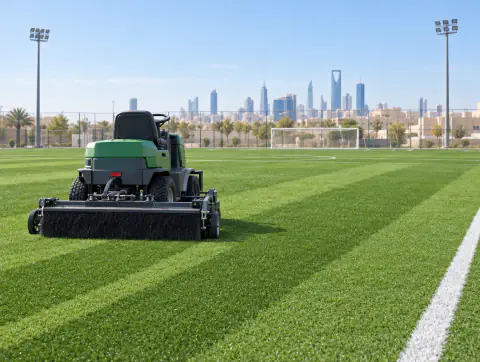
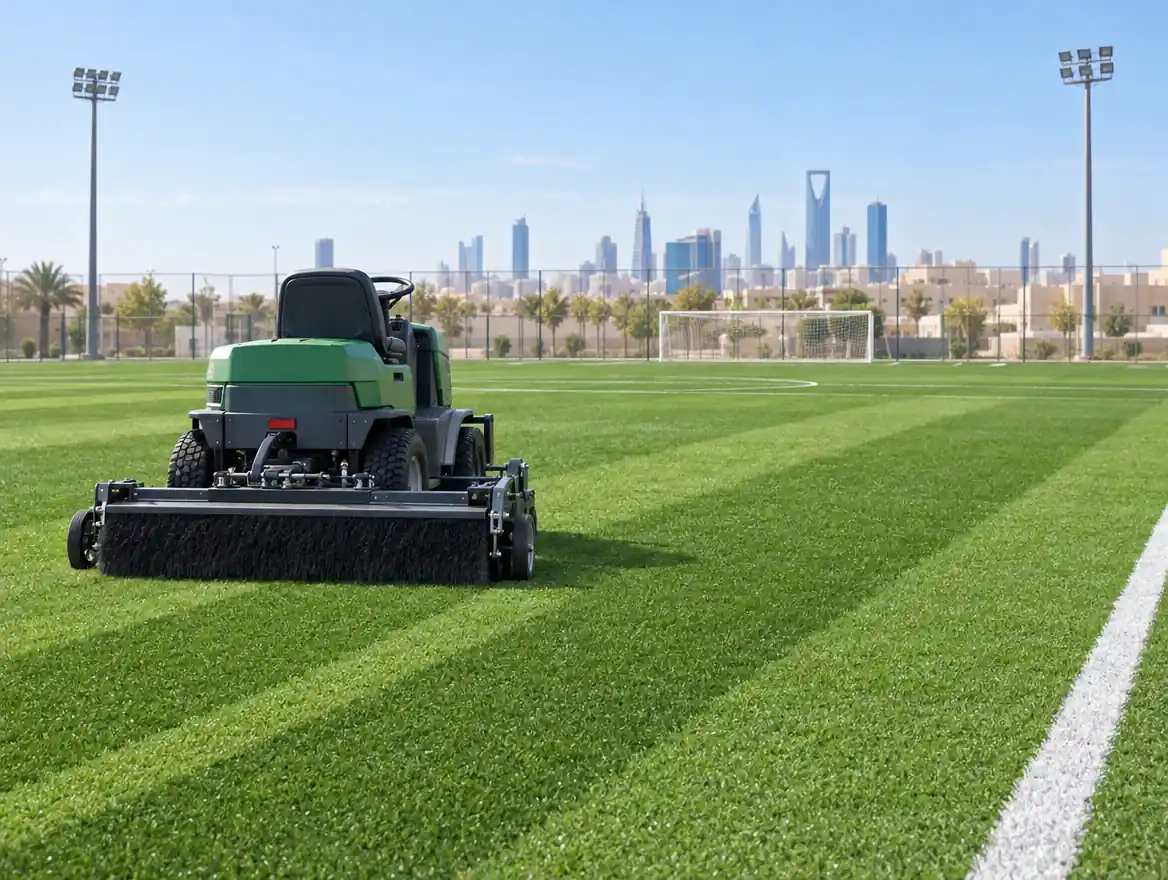
Dirt caught between the fibres is cleared and flattened fibres are lifted back up, because flattening narrows the infill gaps and weakens the surface properties.
- The infill layer
Organic dirt and accumulated sweat are drawn out of the sand or rubber layer, since contaminated infill traps moisture and raises the surface temperature.
- The drainage system
We check that the drainage openings below the surface are clear of blockages, because a blocked drain leaves standing water on the turf and erodes the base from below.
- Line markings and numbers
Coloured line markings printed into or fixed to the fibres are cleaned, as dirt build-up obscures them and makes the pitch hard to read during play.
- Turf edges and fixings
We clean the edges where the turf meets the frame or the wall, as debris builds up there and causes the edge to lift and the fixings to loosen.
- The full surface on completion
The infill is spread evenly across the surface after cleaning, and we check that the fibres are standing in the right direction before the pitch is reopened for use.
Four steps, and done
- 1
Call or message us on WhatsApp
+966 54 084 3018 - 2
Tell us what you notice
Tell us about the turf condition, whether the fibres are flattened, the infill clumped, or the lines faded, which district the facility is in, and the approximate area of the pitch.
- 3
We agree a time and you prepare
We settle on a time that fits your facility schedule, and you clear the turf area of equipment, balls and any movable barriers before we start.
- 4
We do the work and you check
We clean the fibres, infill, drainage, edges and line markings, then you inspect the surface with the team to confirm the infill is spread, fibres are upright and edges are flat.
Some of our work
What our customers say
Real Google Maps reviews, word for word.
شركة نظافة ممتازة يعطيكم العافيه
Google Maps يعطيكم العافيه.. شغل ممتاز يستاهلون ٥ نجوم
Google Maps افضل عمال وتنظيف روووعة يعطيكم العافية
Google Maps
Questions about Artificial-turf cleaning
How do I know my artificial turf needs a specialist clean?
Signs include flattened fibres in high-use areas, clumped infill in certain spots, dark patches that do not clear with routine sweeping, and players noticing that the surface feels slippery or uneven. All of these point to dirt that has settled inside the infill rather than sitting on top.
Does dust affect artificial turf differently from ordinary dirt?
Yes. The fine dust works its way into the infill faster than coarser debris, and in summer heat its particles bind with trapped moisture and form a hard layer that changes the surface character, making it stiffer and less resilient.
What should I prepare before the turf is cleaned?
Clear the turf area completely of balls, equipment, movable goalposts and barriers, check whether the drainage links to a shared system that could be affected, and let us know about any recent repair or infill addition to the surface.
What should I check after the turf is cleaned?
Check that the infill is spread evenly across the full surface with no clumping on one side and low patches on another, confirm the fibres are standing consistently rather than leaning one way, and look over the edges, line markings and drainage to make sure everything runs freely.
Does the work change if the turf pitch is outdoors?
An open pitch faces dust, seasonal wind and direct sun, which means the infill binds more firmly and more material gathers at the surface edges than in an indoor pitch. When you call, tell us whether the pitch is open, shaded or air-conditioned, and the work is planned around that.
More services under Gym & sports facility cleaning