What does pool disinfection cover?
The walls and floor of a pool are always covered by a thin film of water, which means any shift in chemical balance or a gap in regular disinfection leaves its mark on the surface before it shows in the water colour. Fine desert dust adds another layer, settling in corners and along the edges and quietly reducing the effectiveness of disinfection over time.
Pool disinfection is different from simply scrubbing the walls. The work reaches the water lines, the pump, the edges and every surface in contact with the water. Call or message us on WhatsApp, tell us what you have noticed and which district you are in, and we agree a time with you.
These are the parts and surfaces the disinfection covers, depending on the condition of your pool and what you notice in it.
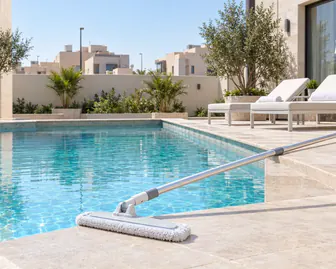
- Pool walls and floor
We treat both tiled and epoxy-coated surfaces, because bacteria and algae cling to the fine pores and hairline cracks in either finish.
- Edges and coping
The coping sits between water and open air, and limescale and dust build up on it, making it the first place algae tend to take hold.
- Water lines and return jets
The internal lines carry water constantly and can hide biological deposits inside them, which is why disinfection covers them and not just the walls.
- Skimmer and suction openings
Skimmer openings are the first to catch dust, insects and floating debris, and keeping them clean directly affects how well the water disinfection cycle works.
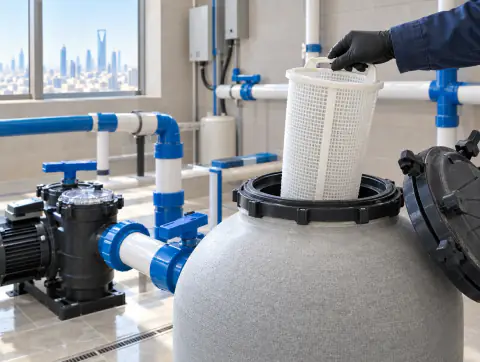
- Circulation pump and pump basket
Debris in the pump basket reduces circulation pressure and causes uneven disinfection in the parts of the pool furthest from the injection point.
- Water surface and overflow channel
Foam and oils floating on the surface obstruct proper disinfection, and the overflow channel, where present, needs cleaning and disinfection together.
Four steps, and done
- 1
Call or message us on WhatsApp
+966 54 084 3018 - 2
Tell us what you notice
Tell us what has changed in your pool: a smell, foam, discolouration on the edges, or a gap in regular disinfection, and which district the property is in.
- 3
We agree a time and what to prepare
We settle on a time that suits you, and you stop the circulation system before we arrive and clear pool toys and equipment from the edges.
- 4
We start the disinfection
We treat the walls, floor, pipework and edges, then wait with you until the water settles and you confirm the smell and appearance are back to normal.
Some of our work
What our customers say
Real Google Maps reviews, word for word.
يعطيكم العافيه.. شغل ممتاز يستاهلون ٥ نجوم
Google Maps شركة نظافة ممتازة يعطيكم العافيه
Google Maps افضل عمال وتنظيف روووعة يعطيكم العافية
Google Maps
Questions about Pool disinfection
How do I know my pool needs disinfection and not just water treatment?
Disinfection targets the surfaces, pipework and pump, while water treatment corrects the chemical balance in the water itself. If you notice sliminess on the walls, a smell coming from the edges, or foam that does not clear with chemistry adjustments, the surfaces are likely the source. Tell us what you notice and we will explain what suits your situation.
Does the pool need to be emptied before disinfection?
Not always. The decision depends on the condition of the pool, the type of surfaces and the degree of contamination. Some disinfection work is done with the water level partially lowered to reach the edges and lines, while other situations call for full draining. We agree on that with you after you describe the situation when you call.
What should I prepare before the pool disinfection appointment?
Stop the circulation and heating system if there is one before we arrive, and move pool equipment, toys and removable ladders away from the edges. If the pool is in a closed villa or a residential compound, let us know in advance so we can arrange access.
The pool smells strong even though we add chlorine regularly, what causes that?
A sharp smell is usually not from the chlorine itself but from chloramines, which form when chlorine reacts with organic matter on the surfaces and inside the lines. That means the surfaces need deep disinfection, because adding more chlorine will not remove the source.
Does disinfecting a small villa pool differ from a compound pool?
Yes, in practical terms: pool size, number of water lines and access to the pump room all affect how the disinfection is done. In compounds access can be restricted and the circulation system larger. That is why we ask about the type of property and pool size when you call, so we prepare the right way.
More services under Swimming pool cleaning