What does rooftop-tank insulation cover?
A rooftop tank sits in full sun all day, and its walls absorb heat that, over time, exceeds what the tank material can handle without change. That daily expansion opens fine cracks or widens existing ones, and the water inside heats to a temperature that makes it uncomfortable to use.
We start by hearing what you notice, whether the water is very hot or damp patches have appeared on the ceiling below, then we insulate from the roof surface down to the base and around all pipe connections. Call or message us on WhatsApp, tell us your district and the tank size, and we agree a time.
These are the parts the work goes through on a rooftop tank, depending on its condition, the material of its walls and what you notice in it.
- The tank roof surface
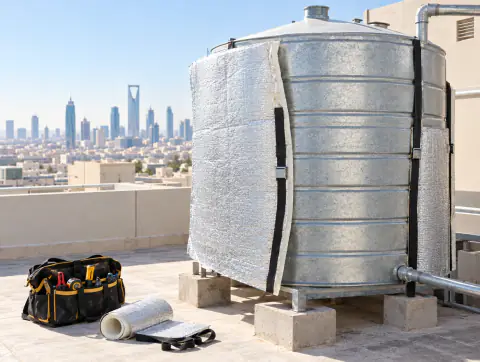
The tank roof faces direct sun all day and is treated first, because heat enters mainly through it and passes into the water inside.
- The outer walls
The outer walls absorb heat from the surrounding air and from radiation reflected off the building roof, and they are insulated to reduce heat transfer into the tank.
- The base and its contact with the roof
The base rests on roof tiles or supports, and that contact conducts heat into the tank from below, so the junction between the base and the roof surface is treated.
- Pipe connection points
Where pipes enter and leave the tank body are weak points where water can seep or cracking can worsen, and these points are treated carefully during the insulation work.
- Existing outer cracks
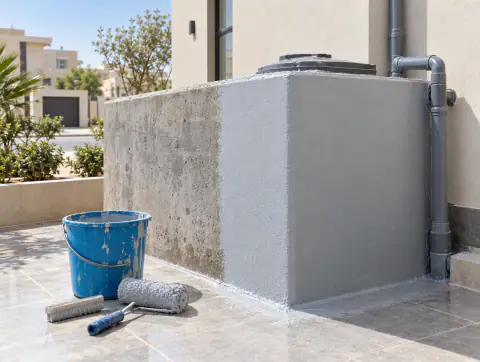
Cracks on the outer walls from expansion are noted and treated before the insulation layer goes on, because leaving them makes the insulation above them incomplete.
- Water level check after the work
After the work the water level is checked to confirm it is not dropping without clear reason, indicating that the treated cracks are no longer letting water out.
Four steps, and done
- 1
Call or message us on WhatsApp
+966 54 084 3018 - 2
Tell us what you notice
Tell us whether the water gets very hot, there are damp patches on the ceiling below or cracks are visible, which district you are in, and roughly what size the tank is.
- 3
We agree a time and you prepare
We settle on a time that suits you, and you make sure the roof is accessible and the area around the tank is clear.
- 4
We do the work and you check after
We insulate the roof, walls, base and pipe connections, and after enough time you check the water temperature and that no new damp patches have appeared on the ceiling below.
Some of our work









What our customers say
Real Google Maps reviews, word for word.
صراحة ممتازين جدا ويهتمون بأدق التفاصيل .. وجدا متعاونين الله يباركلهم .. من أفضل الشركات اللي تعاملت معاها
Google Maps افضل عمال وتنظيف روووعة يعطيكم العافية
Google Maps يعطيكم العافيه.. شغل ممتاز يستاهلون ٥ نجوم
Google Maps
Questions about Rooftop-tank insulation
My rooftop tank water is very hot in summer, does that mean insulation is needed?
Yes, water that gets excessively hot in summer shows that the tank walls and roof are absorbing heat with nothing to slow it down. A rooftop tank faces direct radiation and heat reflected off the building roof, both raising the water temperature. Insulation creates a barrier that slows that heat transfer into the tank.
How do I tell whether the leak is from the rooftop tank itself or from its connected pipes?
If damp appears on the outer walls of the tank or on the ceiling directly beneath it, the source is most likely the tank itself or its pipe connection points. If the damp follows the pipe route away from the tank, the pipe may be the source. Tell us what you notice and we agree on the right approach.
Do I need to drain my rooftop tank before the insulation appointment?
That depends on the scope of work agreed. Insulating the outer walls and roof does not necessarily require draining the tank, but if the work includes treating cracks or pipe connections from inside, lowering the level or draining may be needed. These details become clear when you call and explain what you notice.
What affects the scope of work in rooftop-tank insulation?
What affects the scope: the total surface area of the tank, the wall material whether concrete, fibreglass or steel, the number of cracks and pipe connection points, how easy it is to reach the roof, and whether old insulation needs removing before starting.
After my rooftop tank is insulated, what should I watch in the days that follow?
Watch three things: whether the water temperature has dropped and become comfortable to use, whether the damp on the ceiling below has gone, and whether the water level stays steady. Any new change you notice after the work is worth telling us about.
More services under Water tank insulation